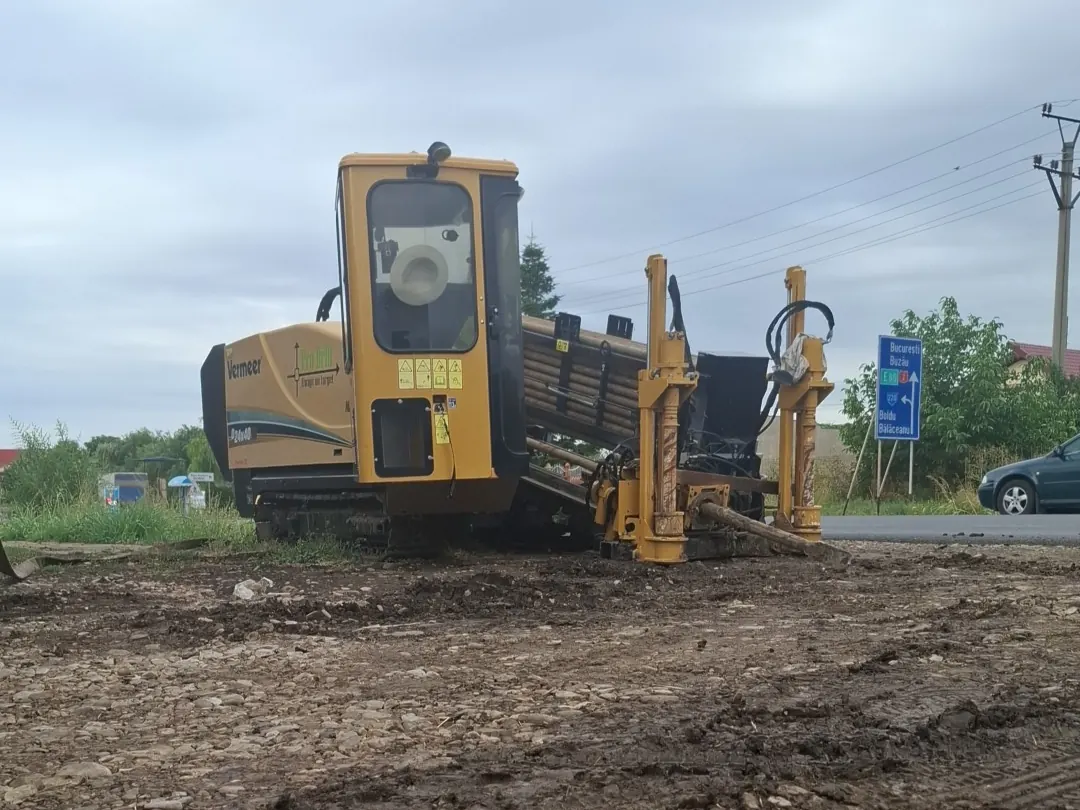
Almost every new network – water, sewer, gas, fibre optic or power cable – has to cross a road at some point. When the road is a national road, managed in Romania by the National Company for Road Infrastructure Administration (CNAIR) through its regional directorates, things become stricter: permits are mandatory, technical conditions are tight and stopping traffic is practically out of the question. That is why horizontal directional drilling is almost always the method used for national roads.
Why drill instead of digging
An open-cut excavation across a national road means cutting through the road structure, closing half the carriageway, traffic lights, rebuilding the road layers and, often, later settlement over the excavation. Road authorities generally avoid this option, and in many cases the permit conditions explicitly require trenchless installation.
With horizontal directional drilling, the pipe passes under the road without touching it. Work is done only at the two points on either side, outside the carriageway and at the distances set in the permit.
Which permits are needed
Permits are usually obtained by the client or the designer, based on the technical documents. For a national road crossing the main ones are:
- The road authority's permit – the CNAIR regional road and bridge directorate, which sets the technical conditions: minimum depth below road level, distance of the work pads from the edge of the carriageway, and whether a protective sleeve is required.
- Consent or authorisation to occupy the road zone, including during the works.
- The building permit for the whole network, of which the crossing is part.
- Where applicable, the traffic police permit for traffic management, although with drilling the impact on traffic is minimal or none.
Exact requirements vary from case to case, so they must be checked for each project. The contractor's role is to provide the technical drilling documents – profile, depths, method and materials – so the permit can be issued without delay.
Technical drilling documents
The documents for a crossing usually include:
- a site plan showing the crossing and the entry and exit points;
- the bore profile, with depth relative to road level and to the side ditches or gutters;
- the specifications of the pipe and of the protective sleeve, if required;
- a description of the method and the safety measures.
We prepare these documents together with the designer, so that the solution in the design is also one that can actually be built.
The protective sleeve
Many permits require the carrier pipe under a national road to be placed inside a protective sleeve, usually steel or PE. The sleeve allows the pipe to be replaced in future without working under the road again. Inside it, the pipe is centred with spacers and the ends are sealed. We deliver the whole assembly: drilling and pulling the sleeve, then inserting the carrier pipe and sealing the ends.
Stages of the work
1. Preparation
Existing utilities in the road zone – cables, pipes, fibre optic – are located on site. The entry and exit points are marked and the work pads are set up outside the carriageway.
2. Pilot bore
The rig drills the pilot bore under the road at the depth set in the permit. The drill head is tracked continuously and the path is corrected so that the minimum depth is respected across the full width of the road zone.
3. Reaming and pullback
The hole is reamed to the required diameter and the sleeve or pipe is pulled in one piece. Drilling fluid stabilises the bore so that no voids form under the road that could cause settlement.
4. Completion
The carrier pipe is inserted (if there is a sleeve), the ends are sealed, the work pads are cleared and the bore log with as-built depths is handed over.
How long it takes
For a typical national road crossing – a few dozen metres, small or medium-diameter pipe – the drilling itself usually takes a single day. For large diameters, longer lengths or difficult ground, it can take a few days. Most of the time is usually spent obtaining permits – which is why getting the technical documents right from the start matters so much.
During the works, traffic on the national road is not affected: the equipment stands on the side pads, and the only signage needed marks the work area. For road users the job goes practically unnoticed – which is exactly the point of a well-executed crossing.
What the client needs to prepare
- valid permits and authorisations;
- access to the work pads on both sides of the road;
- a water source for mixing the drilling fluid (or agreement to bring it in);
- the pipe or protective sleeve, welded or ready for welding, if not included in the quote.
Mistakes that delay a crossing
In our experience, most delays happen not during execution but before it. A few common situations:
- Incomplete technical documents in the permit application. A missing profile or missing depth relative to road level leads to requests for more information and lost months.
- Unsuitable work pads. If the entry and exit points do not respect the required distances or lack access for equipment, the job has to be redesigned.
- Not enough space for the pipe. The pipe must be laid out and welded along the full bore length behind the exit point; sometimes landowners' consent is needed for a few days.
- Unidentified existing utilities. An unknown cable or pipe on the route can stop work until it is clarified.
All of these can be avoided if the contractor is involved from the start – at design stage, or at least before the permit application is filed. An hour's conversation with the designer can save weeks on site.
Projects with several crossings
Long networks often cross several obstacles: national roads, county roads, railways, irrigation canals. Each has its own owner and conditions. Planning all crossings together, with a single mobilisation of equipment, cuts cost and schedule. One example is the project we are currently preparing, with nine crossings of national and county roads, a railway and irrigation canals.
Do you have a national road crossing in your project? Send us the site plan and we will prepare the technical drilling documents and the quote.