
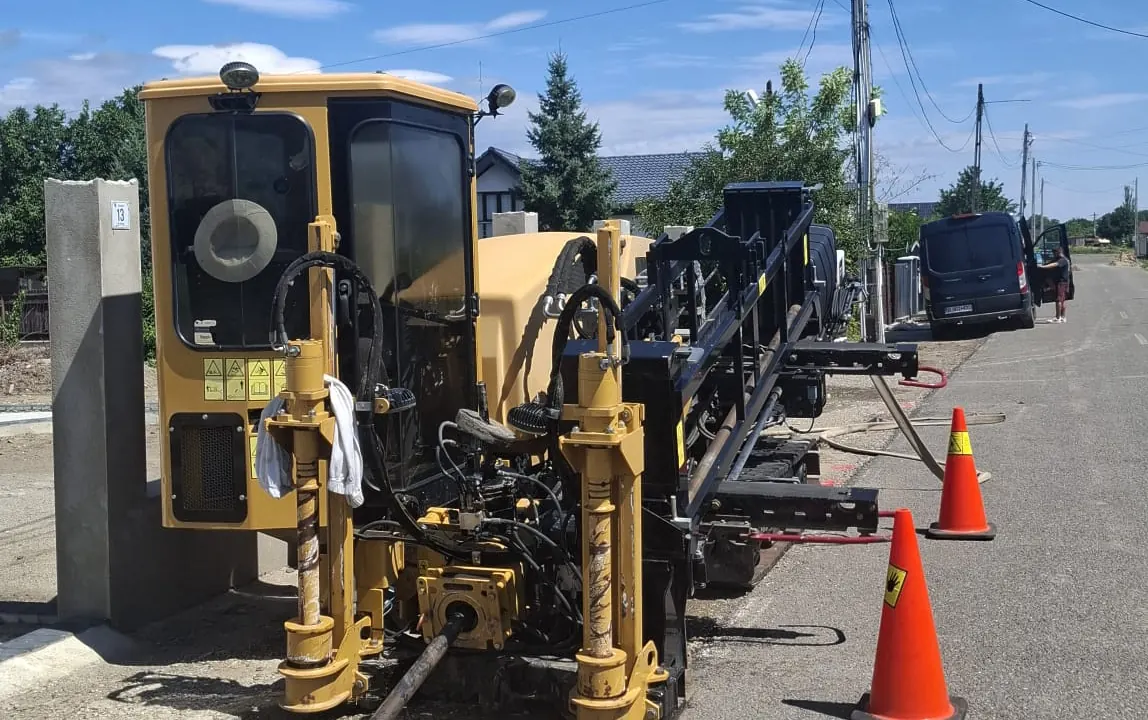
Horizontal directional drilling – HDD for short – has become the standard method for taking pipes and cables under roads, railways, rivers and towns. Even so, many projects in Romania still start from the assumption that a new network automatically means open-cut excavation along the whole route. In this article we explain, in plain terms, what horizontal directional drilling is, how it is carried out and when it is the better choice.
In short: what HDD is
Horizontal directional drilling is a trenchless technology that installs a pipe or protective duct underground between two points on the surface: the entry point, where the rig stands, and the exit point, where the pipe is laid out. Nothing is dug between the two. The road, river, railway or yard above stays untouched.
The key word is "directional". Unlike simple horizontal pushing, the HDD drill head can be steered while drilling: up, down, left or right. The bore can therefore dip under an obstacle, run level at the required depth and then rise towards the exit point, avoiding other existing utilities if needed.
How a bore is carried out, step by step
1. Preparation and drilling plan
Before any drilling, the entry and exit points, the minimum depth under the obstacle and the bore profile are set. A key element is the bend radius: every pipe has a minimum allowable radius below which the material would be overstressed. A large-diameter steel pipe needs much gentler curves than a PE duct for fibre optic. At this stage existing utilities in the area are checked and the known geology is reviewed.
2. Pilot bore
The rig pushes and rotates a string of drill rods with a drill head and an electronic sonde at the front. The sonde transmits position, depth and pitch, and the locator operator on the surface follows the path and passes steering corrections to the rig operator. The result is a small-diameter hole that follows the designed profile.
3. Reaming
Once the drill head reaches the exit point, it is replaced with a reamer. The reamer is pulled back towards the rig while rotating, enlarging the hole. Depending on pipe diameter and ground, reaming is done in one pass or several, with progressively larger reamers. As a rule of thumb, the final hole is about 30–50% larger than the outside diameter of the pipe.
4. Pullback
The pipe, welded in advance on the surface along its full length, is attached behind the last reamer with a pulling head and a swivel that stops it from rotating. The rig then pulls everything back and the pipe takes the place of the reamed hole. Because it is pulled in one piece, there are no buried joints along the drilled section.
The role of drilling fluid
Throughout the job, drilling fluid is pumped through the rods – usually a mix of water and bentonite, with additives chosen for the ground. The fluid cools the drill head, carries cuttings to the surface, stabilises the bore walls and reduces friction during pullback. The right fluid recipe often makes the difference between a successful bore and one that gets stuck, especially in sands and gravels.
Which networks can be installed by HDD
- Drinking water – mains, distribution networks, service connections.
- Sewers – pressure rising mains, vacuum networks and, with precision guidance, even gravity mains.
- Natural gas – PE distribution networks and large-diameter steel pipelines.
- Electricity – low, medium and high-voltage cables, including grid connections for solar and wind farms.
- Telecoms – fibre optic ducts, often several ducts pulled at once.
- Protective sleeves for crossings, into which the carrier pipe is later inserted.
Advantages over open-cut excavation
The right comparison is not just price per metre. You have to count the total cost of the job, including everything open-cut excavation involves:
- No road or pavement reinstatement. In towns, rebuilding the road structure can cost more than laying the pipe.
- No traffic restrictions. No traffic lights, diversions or road closures are needed.
- No shoring or dewatering. At great depths or below the water table, an open excavation needs trench support and pumping. Drilling avoids these costs.
- Speed. A road crossing is usually done in a day; hundreds of metres of pipe can be installed in a few days.
- Lower environmental impact. Crops, tree belts and protected areas are not destroyed, and excavated volumes are small.
- Site safety. People do not work in deep pits, where collapse is the main hazard.
The limits of horizontal directional drilling
Like any technology, HDD has limits, and a serious contractor states them up front:
- Very coarse ground – cobbles or large gravels with no binder – can make drilling difficult or impossible without special methods.
- Space for the pipe. At the exit point there must be room to lay out and weld the pipe along the full bore length, or at least in long sections.
- Bend radii impose minimum distances between entry and exit points and limit the maximum depth reachable over a given length.
- Very long bores – over 500 m in one pull – need a separate analysis, large rigs and careful planning. They are possible: PRO DRILL completed 960 m in one pull under the Timiș river, at a depth of about 17 m.
When to choose HDD
Horizontal directional drilling is almost always the right choice when:
- the route passes under a road, railway, river or canal;
- the work is in a town, on paved streets or with traffic;
- the pipe must be laid deep or below the water table;
- the surface cannot be disturbed (archaeological site, protected area, private property);
- the schedule is short.
If the route runs through open country, at shallow depth and with no obstacles, open-cut excavation may be cheaper. In practice most projects combine the two: open-cut where the ground allows and drilling at every obstacle.
What a contractor needs for a quote
For an accurate quote it helps to have the site plan with the route, the longitudinal profile (if available), the pipe material and diameter, the number of pipes, the bore lengths, the obstacles to cross and any information about the ground. With this data we can estimate time and cost correctly and flag any risks early.
Do you have a project where drilling could be the answer? Send us the drawings and we will check feasibility for free. For a ballpark cost you can also use the calculator on HDD.RO.